

October 2016
 View Full Print Edition
Business Briefs

Business Briefs
By Erin Krueger

Business Briefs
By Erin Krueger
Columns

Overtime Rule Change Takes Effect Dec. 1
By Megan Erickson Moritz

The Definition of Insanity Is...
By Pam Miller


Biomass Policy: States Doing Their Part
By Bob Cleaves


Do Wood Stove Changeouts Work?
By John Ackerly
Featured

At the Heart of the Ethanol Process
By Ann Bailey
Long-time ethanol lab manager, Jennifer Roepke, wears many hats while striving for overall plant success. This article appears in the October print issue of Ethanol Producer Magazine.

Russia Ethanol Production Set to Grow
By Eugene Gerden
Impending tax abolishment to provide the impetus for the development of Russian ethanol industry. This article appears in the October print issue of Ethanol Producer Magazine.

Aemetis' Multiple Ventures
By Susanne Retka Schill
California-based ethanol company moves Edeniq and LanzaTech developments to the forefront. This article appears in the October print issue of Ethanol Producer Magazine.

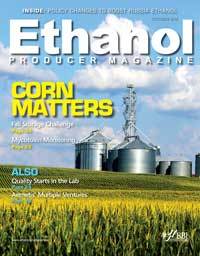
Bin-Busting Bushels
By Ann Bailey
A huge U.S. corn crop is expected to strain storage and pressure prices. This article appears in the October print issue of Ethanol Producer Magazine.

Mycotoxin Monitoring in the FSMA Era
By Susanne Retka Schill
Ethanol plants gear up systems to document compliance. This article appears in the October print issue of Ethanol Producer Magazine.

Molding the Bulk Market
By Ron Kotrba
Solutions are said to be found along the fine line between order and chaos, so perhaps this is where the answer lies to expanding a nascent U.S. bulk wood pellet distribution infrastructure.

Passing the Test
By Katie Fletcher
As college and university fossil fuel heating plants age and become inefficient, many are evaluating, building or have already installed biomass systems.
Contributions

Best Practices for Lab Quality Control
By Matt Kelker
Many samples to be analyzed contain active yeast, active enzymes or both. Thus, proper handling is crucial if one is to avoid spurious results due to the unwanted actions of yeast or enzymes or contaminating microbes. From the October print edition.

Turning CO2 Emissions into Fuel
By Gary C. Young
Process combines carbon dioxide, water and lignin into syngas.

Distributed Biogas: $11.8 Billion Market Hidden in Plain Sight
By Warren Weisman
Rhe mountains of bureaucratic red tape involved in urban food waste biogas projects, where this hidden $11.8 billion market lies, can be easily avoided or greatly reduced by smaller, decentralized biogas plants.

@ Copyright 2026 - BBI International - All rights reserved.